
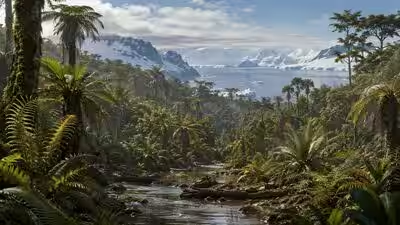
Antarctica once had a rainforest just 900 km from the South Pole. Fossil roots reveal how warm it was 90 million years ago

A sediment core pulled from the seabed off West Antarctica has preserved evidence of a forest that grew near the South Pole about 90 million years ago, when the continent was warm enough to support a wet, temperate ecosystem. The core contains fossilised roots, pollen and spores from vegetation that lived at a latitude of roughly 82 degrees south during the Cretaceous Period. The discovery offers a rare record of what Antarctica looked like before the continent became dominated by its vast ice sheet.The ancient forest also endured several months of darkness each year, yet climate evidence suggests average annual temperatures were around 12°C. Later work on the same core uncovered tiny pieces of amber, adding another clue that resin-producing trees once grew in this unlikely polar setting. The evidence comes from a small geological window, but it provides an unusually detailed glimpse into ancient Antarctica.
South Pole rainforest: Fossil roots reveal ancient Antarctica’s wet forest
The evidence came from a sediment core recovered during a 2017 expedition aboard the German research icebreaker Polarstern. The drilling operation took place in the Amundsen Sea, close to the Pine Island and Thwaites glaciers, from water almost a kilometre deep.One section of the core contained a particularly unusual layer. X-ray computed tomography revealed a network of fossilised roots running through ancient soil. Microscopic examination also identified large quantities of pollen and spores within the same material.The combination was important because pollen and spores can be transported by wind and water. Their presence alone does not necessarily prove that a forest grew at the exact location where they were found. Roots provide much stronger evidence because they developed within the soil where the plants themselves once lived.Chemical clues preserved in the sediment added further information about the environment. The combination of roots, plant remains, soil and chemical indicators allowed scientists to reconstruct a picture of a wet, forested landscape that existed during the Cretaceous Period.The study published in Nature, titled ‘Temperate rainforests near the South Pole during peak Cretaceous warmth’ revealed the core was dated to the Turonian-Santonian interval, between roughly 92 and 83 million years ago. The plant material indicated that a lowland temperate rainforest had grown at a palaeolatitude of about 82 degrees south.
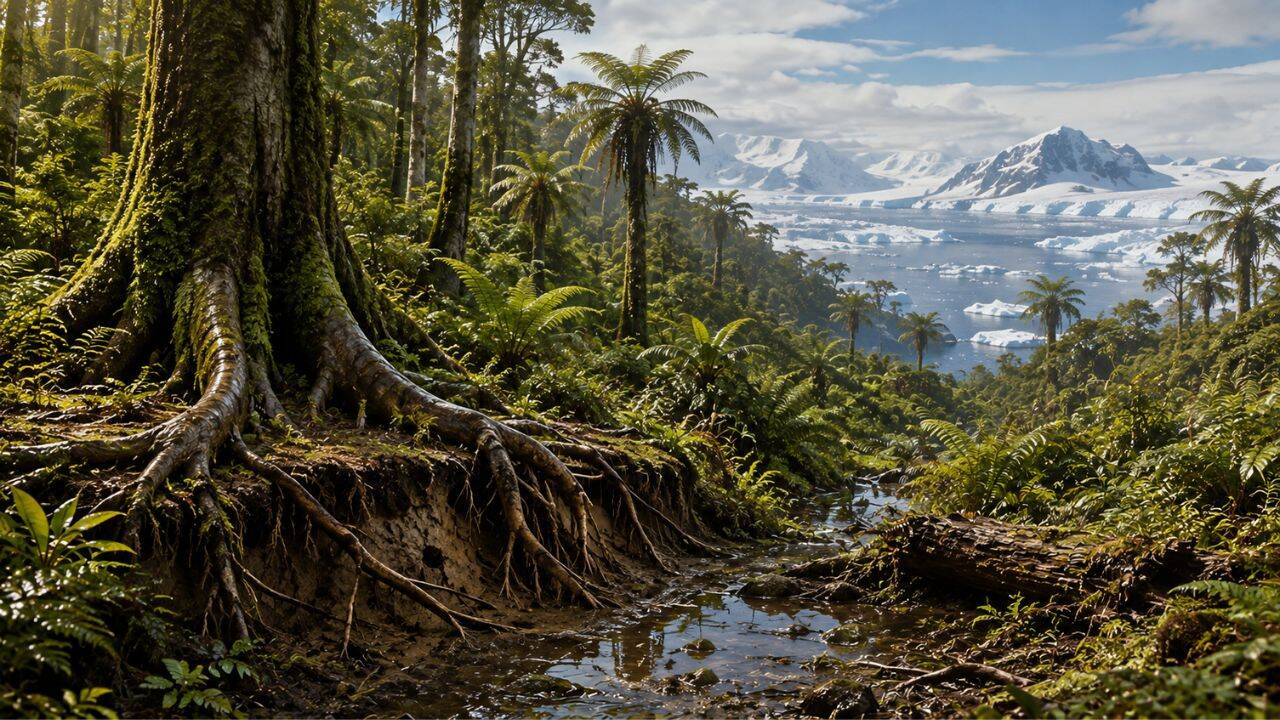
The forest lived through months of darkness
The location of this ancient forest makes its existence particularly unusual. The region was already close to the South Pole when the forest was growing there, so the plants would have experienced a long period each year when the Sun remained below the horizon.The polar night would have lasted for several months. During that time, the plants received no direct sunlight, yet the forest was able to persist through repeated cycles of darkness and summer growth.The reconstructed climate was far milder than the modern Antarctic environment. Scientists estimated that the mean annual air temperature was around 12°C. Summer temperatures may have averaged approximately 19°C, while water in rivers and swamps could have reached around 20°C.This was not a tropical forest growing in permanent heat. The term “temperate rainforest” better describes the environment because it combines abundant moisture with a cooler climate and extreme seasonal changes in daylight.
High carbon dioxide helped create a warmer Antarctica
According to the study, the ancient climate also provides clues about the atmosphere during the Cretaceous. Climate modelling carried out as part of the research found that the reconstructed Antarctic conditions were difficult to reproduce without a largely ice-free continent and considerably higher atmospheric carbon dioxide concentrations than those found before modern industrialisation.The simulations produced plausible conditions when carbon dioxide levels were between roughly 1,120 and 1,680 parts per million. These values are model-dependent, and scientists cannot measure the ancient atmosphere directly in the same way that modern instruments record carbon dioxide.The absence of a major continental ice sheet would also have mattered. Ice reflects a large amount of incoming sunlight, while its disappearance can alter the balance of heat at the surface. Changes in ocean circulation and atmospheric conditions would have influenced the distribution of heat around the southern continent as well.The forest therefore cannot be explained by temperature alone. It was part of a climate system that differed from the modern Earth in several interconnected ways.
The core later revealed traces of ancient tree resin
The evidence for the forest did not end with its roots, pollen and spores. In 2024, scientists reported another discovery from the same core. They had recovered tiny fragments of amber from a layer containing lignite, a type of coal formed from compressed plant material.Reportedly, the amber was named Pine Island amber after the area where the core had been collected. Amber begins as tree resin, so its presence provides another indication that resin-producing trees lived in the region. The fragments were extremely small, measuring around a millimetre before preparation.The material did not contain a spectacular fossilised insect or another large organism. Some fragments appeared to preserve possible traces of bark, while other features were consistent with resin having flowed from damaged areas of a tree.Although the pieces are small, they could eventually reveal more about the ancient forest. Amber sometimes preserves microscopic biological material, and researchers are continuing to examine the Antarctic fragments to determine what information they contain.
Antarctica’s fossil roots offer a direct record of its ancient forest
The fossilised root network is one of the most valuable parts of the discovery because it gives scientists evidence of plants growing directly in the ancient soil.Pollen can travel considerable distances through the atmosphere. Spores can also be moved away from the place where they were produced. Root systems are much more closely tied to their original environment.The preserved roots show that vegetation had established itself in the soil at the location represented by the core. The pollen and spores then provide additional information about the wider plant community.The different forms of evidence can be compared with the chemical characteristics of the sediment. When they point towards the same environmental conditions, the reconstruction becomes more convincing.
An ancient landscape was eventually buried beneath the ocean
The soil in which the plants had grown was eventually buried by layers of sediment. Geological processes altered the landscape over millions of years, and material that had once formed on land became part of the seabed.The modern Antarctic continental shelf therefore contains remnants of environments that existed long before the continent became dominated by its enormous ice sheet.The sediment core effectively allowed scientists to travel through that geological history layer by layer. The drilling equipment brought a narrow cylinder of material back from the seabed, carrying evidence from an ecosystem that had vanished tens of millions of years earlier.
The discovery shows how different Earth’s climate can become
The Antarctic rainforest provides a physical example of how dramatically Earth’s environments can change when the climate system operates under different conditions.The important point is not simply that Antarctica was warmer in the Cretaceous. Scientists already know that the continent has experienced major climatic changes throughout its geological history. The ancient landscape also demonstrates the connections between different parts of Earth’s climate system. Atmospheric carbon dioxide, ocean circulation, ice cover, vegetation and geography all influence the conditions in which ecosystems can exist.
The forest remains hidden in the geological record
There is no visible rainforest beneath the modern Antarctic ice. The trees disappeared millions of years ago, and the landscape that supported them has been transformed by geological and climatic changes. However, a narrow section of sediment still contains traces of that vanished ecosystem.The fossilised roots show where plants once grew. Pollen and spores reveal something about the vegetation that surrounded them. The amber provides evidence that trees produced resin in the same ancient environment.None of these discoveries provides a complete picture on its own. Together, they allow scientists to reconstruct a landscape that once existed almost 90 million years ago in one of the most unlikely places imaginable for a forest.