
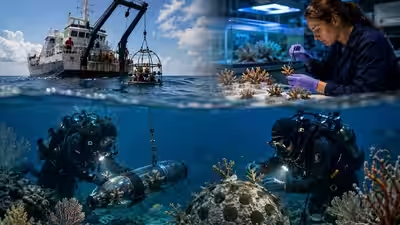
In 2010, Deepwater Horizon damaged deep-sea coral habitats; 16 years later, NOAA divers are planting lab-grown colonies to help rebuild them

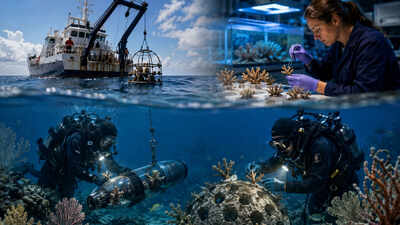
Sixteen years after the Deepwater Horizon oil spill injured extensive coral habitats in the Gulf of Mexico, scientists are developing new ways to help these fragile ecosystems recover. According to NOAA Fisheries, a recent restoration mission combined laboratory-reared corals, specialised technical diving and newly designed equipment to return corals to the deep seafloor.
A damaged deep-sea habitat
The Deepwater Horizon disaster began in April 2010 when the offshore drilling rig exploded in the Gulf of Mexico. The resulting oil spill injured ecosystems, including mesophotic and deep benthic habitats that receive little or no sunlight.Mesophotic habitats occupy the middle-light zone of the ocean and contain coral communities that provide important structure for fish and other marine organisms. Because these environments are far below the surface, studying their condition and restoring them is considerably more difficult than working in shallow coral reefs. According to NOAA Fisheries, the restoration effort is focused on rebuilding these foundational habitats injured by the spill.
Growing corals in laboratories
One of the key advances has been learning how to collect mesophotic corals and maintain them in controlled laboratory conditions. Scientists have studied their reproduction and growth, allowing them to produce new colonies that can eventually be returned to the ocean.Earlier restoration work showed that mesophotic corals could successfully reproduce under human care. In 2021, scientists collected live Swiftia exserta and other corals from the Gulf and brought them to federal laboratories. Within weeks, S. exserta fragments spawned, giving researchers an opportunity to study reproduction, spawning behaviour and larval development. That knowledge has since helped guide restoration techniques. By 2026, researchers were ready to take another step: placing lab-reared corals back onto the seafloor.
A new way to plant corals
The spring 2026 mission aboard the NOAA Ship Nancy Foster focused on outplanting propagated corals, including Swiftia exserta, Muricea pendula and Thesea nivea. Some were placed on specially designed dome-shaped concrete structures intended to support coral growth while also creating habitat for other small marine animals.Getting fragile coral specimens from a ship down to their precise locations hundreds of feet below the surface was one of the biggest challenges. Earlier missions had used large platforms known as coral elevators, but these could be difficult to maneuver and made precise placement challenging.For the 2026 mission, NOAA fisheries biologist Chris Gardner developed a device called the “coral torpedo.” Its streamlined design allows coral specimens to travel quickly through the water to divers waiting at depth. Once there, divers can remove the corals and place them precisely where they are needed. NOAA Fisheries described the device as a prototype that performed better than expected.
Divers work at extreme depths
The restoration required highly trained technical divers because the coral sites were hundreds of feet underwater. Divers used closed-circuit rebreathers, which recycle breathing gas and allow them to remain underwater longer while maintaining appropriate breathing mixtures.The descent is relatively quick, but returning to the surface requires lengthy decompression stops. Divers must pause at multiple depths to allow nitrogen absorbed by their bodies to leave safely and reduce the risk of decompression sickness. A hyperbaric physician was also part of the mission to monitor divers after they returned to the surface.
A major restoration milestone
The 2026 expedition achieved several milestones. The divers successfully outplanted 26 mesophotic corals onto artificial domes at a depth of about 66 metres (217 feet), while relocating 16 coral fragments in the field to start new colonies. The mission also reached depths of 72.5 metres (237 feet), collected biological and sediment samples, and mapped more than 14 square nautical miles of seafloor.Importantly, NOAA Fisheries described this as the first time divers outplanted lab-reared mesophotic corals and the first time rebreather divers propagated corals underwater.
Restoration is still underway
The successful planting does not mean the damaged ecosystem has already recovered. Scientists will continue monitoring the transplanted corals to determine how well they grow and survive in their new surroundings.The project is part of the broader Deepwater Horizon Mesophotic and Deep Benthic Communities Restoration effort, led by NOAA and the Department of the Interior on behalf of the Deepwater Horizon Open Ocean Trustee Implementation Group. The long-term goal is to restore habitats injured by the 2010 spill while improving scientists’ understanding of these difficult-to-reach ecosystems.Sixteen years after the disaster, the restoration effort is therefore moving beyond simply documenting damage. By combining laboratory propagation, innovative equipment and carefully controlled deep-sea diving, scientists are now putting new corals back where they can grow and help rebuild the Gulf’s damaged underwater communities.