
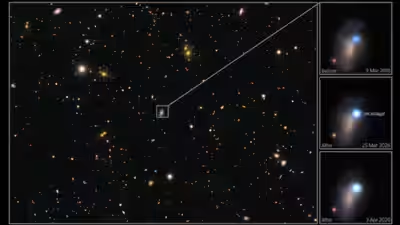
Astronomers caught the first sign of a star 30 times more massive than the Sun exploding, then tracked its supernova for nearly three months

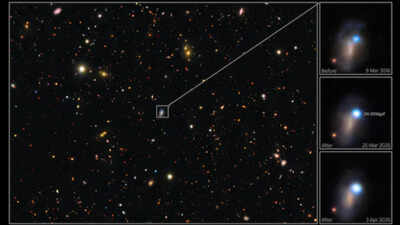
In March, a brief flash of X-rays lit up the sky in a distant galaxy. It lasted only moments, but it carried a profound message: a star had just begun to die.That fleeting signal, detected by China’s Einstein Probe space telescope, marked the first sign of a supernova, the explosive death of a massive star, and it gave astronomers an unprecedented opportunity. For the first time in nearly two decades, researchers were able to observe the entire process, from the initial shock breakout to the fading glow of the supernova, tracking the event for almost three months, according to Reuters.The star, located roughly 500 million light-years from Earth, was estimated to be around 30 times more massive than the Sun. At the very end, it was a rare Wolf-Rayet star, a huge and luminous body that had lost its outer layers of hydrogen and helium thru powerful stellar winds. When it exploded, it left behind what scientists believe is a black hole, an object so dense that not even light can escape its gravity.A rare glimpse of “shock breakout”The first clue came in the form of a sudden X-ray flare, caused by a powerful shock wave tearing through the star’s surface as its core collapsed. This phenomenon, known as “shock breakout,” is thought to occur in every supernova, but it is notoriously difficult to catch. It lasts only a short time, and telescopes must be pointed in exactly the right place at exactly the right moment.The last time such a breakout was observed was in 2008. This new detection offered astronomers a fresh chance to study the earliest moments of a star’s death in extraordinary detail.“It requires serendipity to catch it in real time,” said Brendan O’Connor, a postdoctoral fellow at Carnegie Mellon University and lead author of one of two scientific papers describing the supernova, published in the Astrophysical Journal Letters.Jillian Rastinejad, a NASA Einstein Fellow at the University of Maryland and lead author of the study titled ‘A Multi-Wavelength View of the First Type Ic-BL Supernova with an Einstein Probe X-ray Shock Breakout’, explained the value of the X-ray signal. “You can think of the shock like radar, as the shock plows through the star’s outer layers and any material in the vicinity, it leaves an imprint on the signal that we detect in X-rays. We can use these X-rays to give us an unprecedented, close-up view of the star at the brink of collapse,” she said, according to Reuters.hyperlink: alphaxiv.org/abs/2606.10011v1A global telescope network springs into actionOnce the initial flare was detected, astronomers moved quickly. A network of telescopes, including NASA’s Chandra X-ray Observatory and multiple ground-based facilities, was mobilised to follow the event as it unfolded.For nearly three months, researchers monitored the supernova’s evolution, collecting data across different wavelengths until the star’s location slipped behind the Sun from Earth’s perspective. The sustained observations allowed scientists to piece together a detailed timeline of the explosion, from the first shock to the expanding debris cloud.The star’s explosion was classified as a “broad-lined Type Ic” supernova. This type involves a star that has lost its outer hydrogen and helium layers, and the material ejected by the blast moves at extreme velocities, in this case, more than 10% of the speed of light.No gamma-ray burst:And why that mattersMany powerful supernovae are associated with gamma-ray bursts, intense flashes of the highest-energy form of light. These bursts are thought to be produced when jets of material, moving near the speed of light, escape the star and collide with surrounding matter.But this supernova showed no evidence of a gamma-ray burst. That absence is scientifically significant.“One of the central unanswered questions in the field is why some collapsing massive stars launch jets of material near the speed of light that escape the star and produce gamma-ray bursts, while apparently similar stars do not,” O’Connor said.One possibility is that the jet was “choked”, prevented from breaking out, either by the star’s surface or by dense material surrounding it in its final stages. “The existence of choked jets was theorised decades ago, but yet to be conclusively identified,” O’Connor added.This was the first supernova of its type observed without a gamma-ray burst or an escaping jet. The finding suggests that the most massive stars can die in more ways than astronomers previously thought.A laboratory for extreme physicsSupernovae are more than spectacular cosmic fireworks. They are natural laboratories for studying physics under conditions that cannot be recreated on Earth — extreme densities, temperatures and masses far beyond anything achievable in terrestrial experiments.“These extreme supernovae are laboratories for astrophysicists to study how the laws of physics behave in extreme environments, think high densities, high temperatures, material that is several times the mass of our Sun, that we can’t recreate here on Earth. By studying them, we learn more about the laws of our universe,” Rastinejad said.The observations also help refine models of how massive stars end their lives, how black holes form and how heavy elements are forged and scattered into space. Supernovae are responsible for creating many of the elements that make up planets, stars and even life itself.A star larger than BetelgeuseThe exploding star was likely larger than Betelgeuse, one of the brightest and most well-known stars in the night sky. Betelgeuse, a red supergiant in the constellation Orion, is also expected to end its life in a supernova, though it is much closer to Earth, about 500 to 600 light-years away.Watching a similar, though far more distant, star explode gives astronomers a preview of what might one day happen in our own galactic neighbourhood. It also underscores how much remains to be learned about the final moments of stellar evolution.Why this discovery mattersCatching a supernova from its very first moments is rare. Tracking it for weeks afterward is even rarer. “By combining early detection with continued follow-up, we get a full picture of how a massive star goes from life to death.The data collected will aid scientists better understand:How a shock wave moves thru the outer layers of a starWhy do some supernovae give gamma-ray bursts and some don’tFormation of black holes after core collapseWhat are the environments of massive stars at the end of their lives?The finding also emphasizes the importance of space-based telescopes and international cooperation in modern astronomy. Without the early alert from the Einstein Probe and the rapid response of the world’s observatories, this transient moment would have been lost.A look into the life and death of starsFor astronomers a supernova is a story, a story written in light, X-rays and expanding gas. This story, in particular, began with a quick flash, then played out over months of careful observation. It revealed a star that was far more massive than the Sun, dying in a way that defied expectations.The event may be past, but its effects will remain. The data will feed models of stellar evolution, black-hole formation and how matter behaves under extreme conditions for years to come.500 million light years is a long way out in the vastness of the universe. But in the quest to understand how stars live and die, this explosion feels awfully close — a reminder that even in the most violent endings there is knowledge to be gained.(With inputs from Reuters)